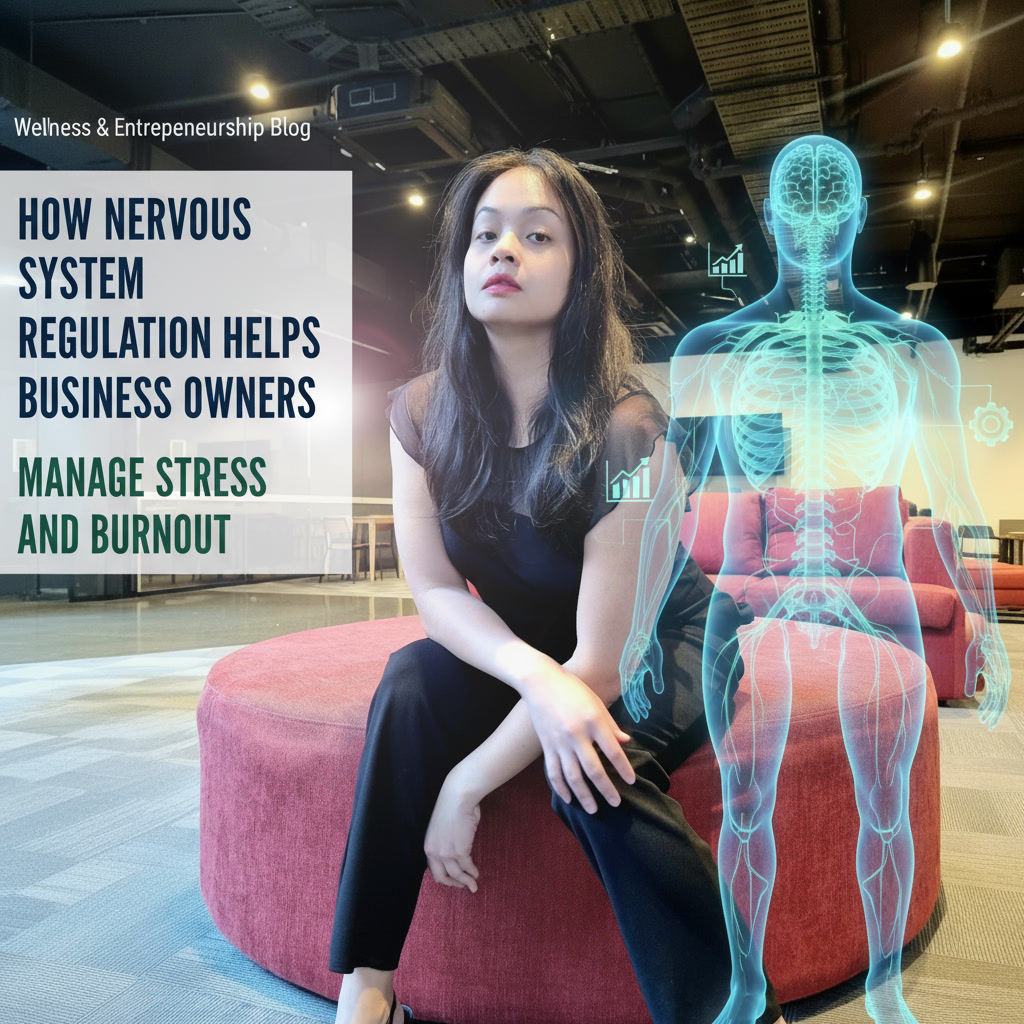
Running a business can be exciting and rewarding, but entrepreneurship also comes with pressure, uncertainty, long hours, financial responsibility, and constant decision-making. For many entrepreneurs, the business never truly feels “off.” Emails arrive after work, customers need attention, employees need support, and important decisions can appear at any moment.
Over time, this constant pressure can contribute to chronic stress, emotional exhaustion, and burnout.
This is why nervous system regulation for business owners has become an increasingly important topic in conversations about sustainable entrepreneurship and leadership. Rather than focusing only on productivity, time management, or working harder, nervous system regulation looks at how business owners can recognize stress responses, create opportunities for recovery, and develop healthier ways of responding to pressure.
For entrepreneurs searching for stress management for business owners, nervous system regulation can become one part of a broader strategy that includes healthy boundaries, adequate recovery, physical activity, realistic workloads, delegation, and professional support when appropriate.
The goal is not to eliminate stress.
The goal is to build a business and lifestyle where stress does not control every decision.
What Is Nervous System Regulation for Business Owners?
Nervous system regulation for business owners refers to practices and habits that can help a person respond to stressful situations more intentionally and return toward a calmer state after pressure.
The autonomic nervous system plays an important role in automatic functions such as heart rate, breathing, and other physiological processes. During demanding situations, the body’s stress response can prepare a person to respond to a challenge. Recovery is equally important because people are not designed to remain in a heightened state indefinitely.
For entrepreneurs, this concept is particularly relevant because business ownership can involve repeated uncertainty.
A business owner may worry about:
- Revenue and cash flow
- Customer complaints
- Employee performance
- Hiring decisions
- Business growth
- Marketing results
- Competition
- Deadlines
- Taxes and expenses
- Difficult negotiations
- Major business decisions
- The future of the company
One stressful event may not be a major problem. The challenge is when stressful events happen continuously without sufficient recovery.
Nervous system regulation is therefore not about trying to remain calm every second.
It is about developing greater flexibility between activation, action, recovery, and rest.
Why Business Owners Experience So Much Stress
Entrepreneurship combines responsibility with uncertainty.
An employee may finish their shift and leave work behind. A business owner may leave the office physically while continuing to think about the business mentally.
You might be eating dinner while thinking about tomorrow’s meeting.
You might be trying to sleep while calculating next month’s expenses.
You might be spending time with family while wondering why a client has not responded.
This inability to mentally disconnect can make recovery difficult.
Recent discussions around entrepreneurial burnout increasingly emphasize the unique combination of workload, decision-making, financial uncertainty, and blurred personal-professional boundaries faced by business owners.
This makes stress management for business owners different from simply taking an occasional day off.
Sustainable stress management requires both personal recovery strategies and practical changes to the business itself.
What Is Business Burnout?
Business burnout is commonly used to describe severe and prolonged exhaustion associated with the demands of running a business.
The World Health Organization describes burnout as an occupational phenomenon resulting from chronic workplace stress that has not been successfully managed.
Burnout can involve:
- Extreme exhaustion
- Emotional distance from work
- Cynicism or negativity
- Reduced professional effectiveness
- Loss of motivation
- Difficulty concentrating
- Irritability
- Feeling overwhelmed
- Difficulty enjoying business successes
For entrepreneurs, burnout may be especially difficult to recognize because they often continue working even when their energy and motivation are declining.
You may still answer emails.
You may still attend meetings.
You may still meet deadlines.
But internally, you may feel completely exhausted.
That is why business burnout recovery should not simply mean taking a weekend away from your laptop.
Recovery may require identifying the patterns that created the exhaustion in the first place.
Business Burnout Recovery Starts With Recognizing the Warning Signs
Effective business burnout recovery begins with awareness.
Many business owners notice burnout only after productivity has already declined significantly.
Early warning signs may include:
Constant Mental Overactivity
Your body may be resting while your mind continues working.
You repeatedly think about unfinished projects, financial concerns, customers, employees, or future decisions.
Irritability
Small problems suddenly feel much bigger than they normally would.
You may become impatient with employees, customers, partners, or family members.
Decision Fatigue
Simple decisions begin to feel exhausting.
You may postpone important decisions because your mental capacity feels depleted.
Loss of Motivation
The business that once excited you may begin to feel like an obligation.
Even achieving important goals may no longer feel satisfying.
Difficulty Disconnecting
You may check email late at night, respond to messages during family time, or think about work immediately after waking up.
These signs should not automatically be interpreted as a medical diagnosis. However, they can be useful signals that your current workload, recovery habits, or business structure may need attention.
How Nervous System Regulation Can Support Business Burnout Recovery
Business burnout recovery is usually more effective when recovery becomes part of everyday life rather than something postponed until a crisis occurs.
1. Create Short Recovery Periods
You do not necessarily need an hour-long meditation session to create a recovery habit.
Small pauses throughout the day can provide opportunities to step away from continuous work.
For example:
- Stand up between meetings.
- Walk outside for a few minutes.
- Take several slow, comfortable breaths.
- Stretch your shoulders and neck.
- Step away from your computer.
- Drink water without checking your phone.
- Spend a few minutes in a quiet environment.
The objective is to create regular transitions between periods of intense concentration.
2. Use Breathing as a Transition Tool
Breathing exercises are often used as simple stress-management practices.
A business owner can use slow, comfortable breathing before:
- An important presentation
- A difficult conversation
- A sales call
- A negotiation
- Responding to an angry customer
- Making an important decision
The goal is not to magically eliminate stress.
Instead, a short breathing pause can create space between an emotional reaction and your next action.
3. Build Movement Into the Workday
Physical activity can be another useful component of stress management.
You might take a short walk after a difficult meeting, exercise before work, stretch between projects, or schedule movement during lunch.
The key is consistency.
A 10-minute walk that happens regularly may be more realistic than an ambitious exercise plan that never becomes a habit.
4. Create a Workday Shutdown Routine
One of the simplest strategies for stress management for business owners is creating a clear end-of-day transition.
Before finishing work:
- Review today’s completed tasks.
- Write down unfinished items.
- Identify tomorrow’s priorities.
- Close unnecessary browser tabs.
- Shut down the computer.
- Turn off nonessential business notifications.
- Move into a non-work activity.
This gives your brain a clear signal that the workday has ended.
Burnout Prevention for Entrepreneurs Requires Business Boundaries
One of the most important aspects of burnout prevention for entrepreneurs is creating boundaries around work.
Entrepreneurs often believe being constantly available demonstrates commitment.
But constant availability can become unsustainable.
Consider establishing:
- Business communication hours
- Customer response expectations
- Meeting-free periods
- Email boundaries
- Weekend boundaries
- Vacation policies
- Delegation procedures
- Emergency definitions
For example, if customers know that routine messages will receive a response during business hours, you may not need to monitor your inbox continuously.
Boundaries are not about providing poor customer service.
They are about creating a sustainable operating system for the business.
How to Build a Business Without Burning Out
Many entrepreneurs eventually ask:
How do I grow my business without sacrificing my health and personal life?
The answer begins with understanding that growth and overwork are not the same thing.
If business growth depends entirely on you working more hours, the business may eventually reach a ceiling.
Learning how to build a business without burning out means creating systems that allow the company to grow without requiring the owner to personally handle every task.
Delegate Repetitive Work
Identify tasks that do not require your direct involvement.
These might include:
- Administrative work
- Scheduling
- Basic customer support
- Data entry
- Reporting
- Routine marketing tasks
- Appointment management
Delegation gives the business owner more time for strategic responsibilities.
Automate Where Appropriate
Technology can reduce repetitive work.
Automations can help with:
- Email responses
- Appointment reminders
- Invoicing
- Customer follow-ups
- Reporting
- Internal notifications
- Content workflows
The goal is not to automate everything.
The goal is to remove unnecessary friction.
Stop Treating Everything as an Emergency
When every task feels urgent, the nervous system has little opportunity to recover.
Create categories such as:
Urgent: Requires immediate attention.
Important: Needs attention today or this week.
Routine: Can be scheduled.
Delegatable: Someone else can handle it.
This simple framework can reduce unnecessary pressure.
Burnout Prevention for Entrepreneurs Starts With Sustainable Leadership
Burnout prevention for entrepreneurs is not only about self-care.
Leadership style matters.
If the business owner constantly works late, answers messages at midnight, changes priorities every hour, and expects immediate responses, employees may feel pressured to behave the same way.
A healthier leadership model demonstrates:
- Clear priorities
- Realistic deadlines
- Reasonable communication expectations
- Delegation
- Recovery
- Accountability
- Flexibility
Your team learns from what you consistently demonstrate—not only from what you tell them.
How Nervous System Regulation Can Support Better Decision-Making
Business owners make decisions constantly.
Should you hire?
Should you increase prices?
Should you launch a new service?
Should you fire a difficult client?
Should you expand?
Should you invest?
When you’re overwhelmed, every decision can feel urgent.
A short pause can help you distinguish between an actual emergency and an emotionally intense situation.
Before making an important decision, ask:
What is actually happening?
Separate facts from assumptions.
What decision truly needs to be made today?
Not every problem requires immediate action.
What is the next practical step?
You do not always need to solve the entire problem at once.
Am I responding or reacting?
This question can be particularly useful during difficult conversations.
A Simple Daily Routine for Nervous System Regulation
You can incorporate nervous system regulation for business owners into a normal workday without dramatically changing your schedule.
Morning
Before immediately checking messages:
- Take several slow breaths.
- Drink water.
- Move your body.
- Identify your top three priorities.
- Avoid starting the day by reacting to every notification.
During Work
Between major tasks:
- Stand up.
- Walk briefly.
- Relax your shoulders.
- Take a few comfortable breaths.
- Look away from your screen.
Before Difficult Conversations
Pause before responding.
Take a breath.
Identify the actual issue.
Decide what outcome you want.
Then communicate.
End of the Workday
Write down unfinished work.
Plan tomorrow.
Close your computer.
Turn off unnecessary notifications.
Transition into personal time.
Evening
Protect time that has nothing to do with business.
Spend time with family.
Read.
Exercise.
Enjoy a hobby.
Take a walk.
Or simply rest.
Recovery is not wasted time.
It is part of sustainable performance.
How to Build a Business Without Burning Out: A Practical Checklist
If you’re learning how to build a business without burning out, start with these questions:
- Can I delegate any recurring tasks?
- Do I have clear working hours?
- Do customers know when I am available?
- Do I take genuine breaks?
- Do I regularly exercise or move?
- Do I protect my sleep?
- Do I have time away from screens?
- Am I saying yes to too many projects?
- Does every decision really need my approval?
- Can technology automate repetitive work?
- Do I have someone I can discuss difficult business decisions with?
- Can my business operate for a short period without me?
The goal is not perfection.
The goal is creating a business model that does not require constant personal sacrifice.
Is Nervous System Regulation Enough to Treat Burnout?
No single technique should be presented as a guaranteed treatment for burnout.
Nervous system regulation practices may be useful as part of a broader stress-management approach, but business owners should also address the underlying causes of chronic stress.
If the workload is unrealistic, breathing exercises alone will not fix the workload.
If the company has poor communication, meditation alone will not solve the organizational problem.
If an entrepreneur is experiencing persistent psychological or physical symptoms, professional medical or mental-health support may be appropriate.
Effective business burnout recovery may require both personal changes and structural business changes.
Frequently Asked Questions About Nervous System Regulation and Business Burnout
What is nervous system regulation for business owners?
Nervous system regulation for business owners is a collection of practices and habits intended to support healthier responses to stress and better recovery after stressful experiences. It can include breathing, mindfulness, movement, rest, boundaries, and workload management.
How can business owners recover from burnout?
Business burnout recovery can involve reducing excessive workload, improving sleep and recovery, creating work boundaries, delegating responsibilities, incorporating physical activity, and seeking professional support when needed.
What is burnout prevention for entrepreneurs?
Burnout prevention for entrepreneurs involves identifying chronic stressors before they become overwhelming and creating sustainable systems for workload, communication, recovery, delegation, and personal well-being.
What are the best stress management strategies for business owners?
Effective stress management for business owners can include regular physical activity, adequate sleep, breathing or mindfulness practices, realistic scheduling, delegation, clear communication boundaries, recovery periods, and professional support when appropriate.
How can I build a business without burning out?
Learning how to build a business without burning out requires designing the company around sustainable systems rather than constant personal effort. Delegation, automation, clear boundaries, realistic workloads, and strategic prioritization can help reduce unnecessary pressure.
Can nervous system regulation improve business performance?
Nervous system regulation should not be treated as a guaranteed productivity technique. However, healthier stress-management and recovery habits can support a business owner’s ability to pause, think clearly, communicate effectively, and make deliberate decisions.
Should I take time off if I feel burned out?
Taking time away from work can provide recovery, but if chronic workload or organizational problems remain unchanged, symptoms may return when work resumes. Sustainable recovery should address both rest and the underlying sources of excessive stress.
Final Thoughts: Build a Business That Supports Your Life
Entrepreneurship should not require you to sacrifice your well-being in order to succeed.
The most sustainable business is not necessarily the one where the owner works the longest hours.
It is the one where the owner can lead effectively, recover from pressure, delegate responsibility, make thoughtful decisions, and still have a life outside the business.
Nervous system regulation for business owners can be one useful component of that approach.
But sustainable entrepreneurship goes further.
It means practicing stress management for business owners.
It means taking business burnout recovery seriously.
It means investing in burnout prevention for entrepreneurs before exhaustion becomes overwhelming.
And it means understanding how to build a business without burning out by creating systems, boundaries, and workflows that support long-term growth.
Your business should be an asset to your life—not something that consumes it.
Take Action Today
Start with one small change.
Take a short break between meetings.
Set a firm end-of-day boundary.
Delegate one task.
Turn off unnecessary notifications.
Schedule time for movement.
Or identify one responsibility that no longer needs to be handled personally.
Small changes can create the foundation for a healthier and more sustainable way to lead.
You don’t have to choose between building a successful business and protecting your well-being. The goal is to build a business that makes both possible.
To learn more, contact us